


This Is Not a Meal: The Science Behind Everyday Snacks
A rusk dunked in coffee is one of the small pleasures of a morning, and a packet of chips has rescued plenty of long afternoons. There’s nothing wrong with any of these snacks, but they're exactly that.
None of them is a meal, and none of them is trying to be.
Things change when a snack ends up in a meal’s place because the hours ran out...
Look at what’s happening inside you when that happens and the science tells a story your hunger never mentions.
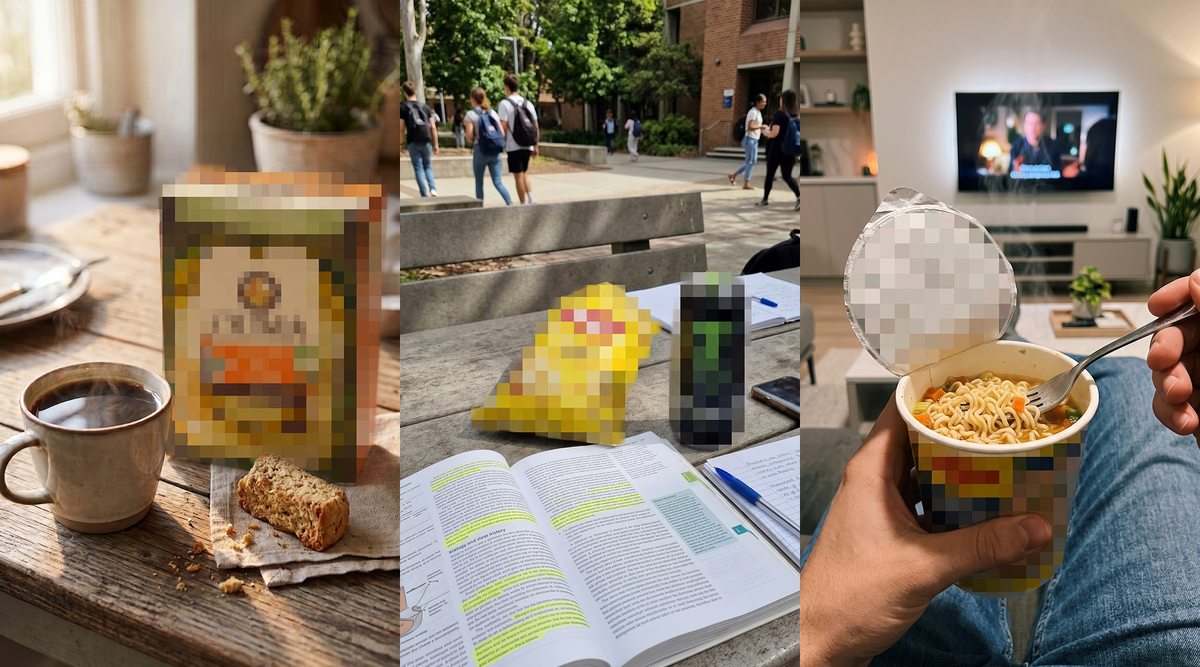
This is not a meal: coffee and a rusk
While you sleep, your body keeps your blood sugar steady by drawing on glycogen, a store of carbohydrate held in your liver. By morning a good part of it has been used. Your brain depends on a steady supply of glucose to work well, so the first food of the day has real work to do.
The coffee feels like it’s doing that work. Caffeine blocks adenosine, a compound that builds up the longer you’re awake and makes you feel tired. You feel sharper, but the coffee itself supplies almost no energy.
The rusk is what supplies it, and how long that lasts depends on the kind of carbohydrate. The glycaemic index measures how quickly a food raises your blood sugar. Quickly digested carbohydrates arrive fast, which is handy when you need energy right now, while slowly digested ones release glucose gradually so your energy comes through as a steadier stream. A rusk is mostly refined flour, which your body digests fairly quickly, so it looks after the first part of the morning nicely and leaves the rest to whatever comes next.
This is not a meal: a packet of chips
When lunch gets swallowed by a deadline, a packet of chips takes the edge off fast. Here’s why that feeling doesn’t always last.
The stretch of your stomach is the first sign that food has arrived. The longer-lasting signal comes from further down. As food moves into your small intestine, cells in the gut wall release hormones such as CCK, GLP-1 and PYY, which travel to your brain and turn hunger down. Protein is particularly good at triggering them, and fibre slows how quickly your stomach empties, so the signal is drawn out over hours.
Chips do carry fat, and fat slows digestion too, which is part of why they satisfy. With little protein or fibre alongside it, the conversation with your gut is simply shorter.
Fat has another job worth knowing about. Vitamins A, D, E and K are fat-soluble, which means your body needs some fat in the same meal to absorb them properly. Fat on its own does very little with that ability. It does its best work as part of a plate.
This is not a meal: an energy drink
When the afternoon dip hits and there’s no time to eat, an energy drink is the quick answer. The side of the can usually lists B vitamins, and that’s where things get easy to misread.
B vitamins are essential. The enzymes that release energy from carbohydrates, fat and protein need them to work. What B vitamins can’t do is create energy on their own. If there’s been little food for them to work on, there’s little for them to release, and the lift you feel comes mostly from the caffeine and any sugar in the can.
Most B vitamins, along with vitamin C, are water-soluble, so your body doesn’t keep large reserves of them (B12 is the exception, which the liver can store). Regular meals are how those levels stay topped up.
This is not a meal: Instant Noodles
When you get home with nothing left, noodles take two minutes, and after a long day that’s a perfectly reasonable thing to want.
Instant noodles are mostly wheat, so they bring less protein than a plate of supper usually would, and protein is the one nutrient your body can’t put aside for later. It stores spare energy as glycogen or fat, but it has no dedicated store for protein. Amino acids are used around the clock to repair tissue and to make enzymes, hormones and immune cells, so your body relies on a steady supply. Research on protein timing suggests the body makes better use of it when it arrives in several decent portions through the day.
Fibre tends to be light in a bowl of noodles too, and some of it was meant for someone else. Certain fibres pass through you undigested to your large intestine, where your gut bacteria ferment them into short-chain fatty acids that help nourish the cells lining your colon.
There’s also a detail that reaches into the next day. Researchers studying blood sugar found what they call the second-meal effect: a meal with slowly digested carbohydrates and fibre can soften the blood sugar rise at your next meal, and they’ve seen it carry overnight, with supper shaping how your body handles breakfast.
So when does food count as a meal?
Each of these snacks does what it was made for. Coffee wakes you up, a rusk gets a morning going, chips take the edge off and noodles are there when nothing else is. The gap only appears when one of them is asked to do the whole job of a meal.
What a meal adds is breadth. It brings energy and protein in together, with fibre and fat slowing things to a steady pace, and enough variety that the vitamins and minerals come along without anyone counting them.
A snack ending up as a meal is rarely a choice. It’s a meeting that ran over, back-to-back lectures, a shift that finished an hour late. Food becomes something for later, and later keeps moving.
Where MaxiMeal fits in
MaxiMeal fills the gap when a real meal isn’t possible. That means one of those moments, the lunch that got eaten by a deadline or the breakfast you didn’t have the appetite for. Your other meals still matter as much as ever.
A 60 g serving is put together to do the jobs a meal does. You get 13.7 g of protein from milk, a mix of fast-digesting whey and slower casein, and carbohydrates from Palatinose, which is made of the same two sugars as table sugar joined by a different bond that your body takes longer to break down, so glucose is released gradually. Coconut MCTs provide a source of healthy fats that your body absorbs and uses quickly. There’s 5.6 g of fibre, including the prebiotic fibres Fibersol-2 and Nutriose, alongside the probiotic LactoSpore. And it carries 23 vitamins and minerals, among them vitamins A, D and E arriving with fat to help absorb them, and the full B group, with B12 and folate in methylated forms.
Scoop or pour, shake, and it’s ready in seconds.
The rusk, the chips and the noodles can all stay. When one of them is about to become your meal, give your body what a meal would have brought.


